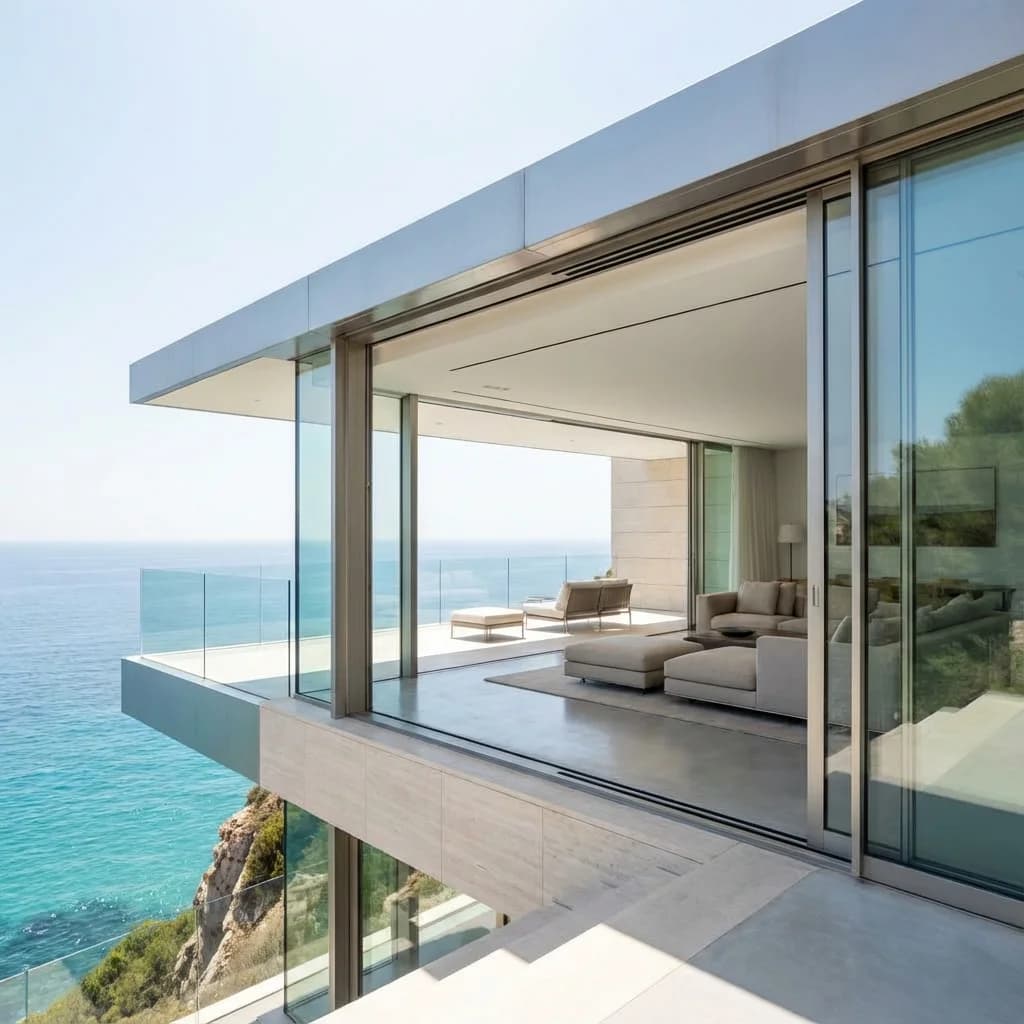
The architectural narrative of the 21st century is defined by light. As we move away from the heavy, enclosed structures that characterized much of architectural history, the boundary between the built environment and the natural world is dissolving. This is not merely a stylistic trend but a fundamental shift in how we inhabit space.
We are witnessing the era of "Invisible Architecture," where the goal is not to impose a structure upon a landscape, but to let the landscape flow through the structure. At the heart of this revolution lies the advancement of minimalist sliding door systems.
From Cave to Crystal: A Historical Shift
For millennia, the primary function of a wall was structural support and protection. Windows were mere punctures in the fabric of a building, limited in size by the limitations of stone and brick. Today, that paradigm has been inverted.
With the advent of high-strength structural glazing and reinforced aluminum alloys, walls have become windows, and windows have become walls. We no longer look at a view; we live within it.
The Psychology of Transparency
The impact of this shift extends far beyond aesthetics. It touches upon Biophilic Design—the inherent human need to connect with nature.
- Stress Reduction: Studies show that unobstructed views of nature significantly lower cortisol levels.
- Circadian Rhythm: Flooding interiors with natural light regulates our sleep-wake cycles, improving mood and productivity.
- Spatial Perception: Eliminating visual barriers "borrows" space from the outdoors, making interiors feel infinitely larger.
"Architecture should speak of its time and place, but yearn for timelessness. The true luxury of modern living is the freedom of view."
Technological Enablers: How It Works
Achieving total transparency requires overcoming immense engineering challenges. How do you support a multi-ton glass panel with a frame that is barely visible?
The answer lies in Structural Glazing and Hidden Frameworks. In modern minimalist systems like Slidy Doors, the aluminum profile is often recessed entirely into the floor, ceiling, and walls. The only visible element is a slim vertical interlock, often just 20mm wide.
Furthermore, the glass itself has evolved. It is no longer a fragile infill but a structural component capable of bearing significant wind loads and thermal stresses.
The Future is Kinetic
Looking ahead, the next frontier is automation. We are moving towards "Kinetic Facades" where entire glass walls disappear at the touch of a button or voice command. Integration with Smart Home systems (IoT) allows these architectural elements to respond to weather conditions, closing automatically when it rains or opening to ventilate when the air quality is optimal.
Conclusion
The future of architecture is clear—literally. As we continue to push the boundaries of materials science, the definition of "shelter" is evolving from a fortress that keeps nature out, to a sanctuary that invites nature in, without compromising on comfort or safety.