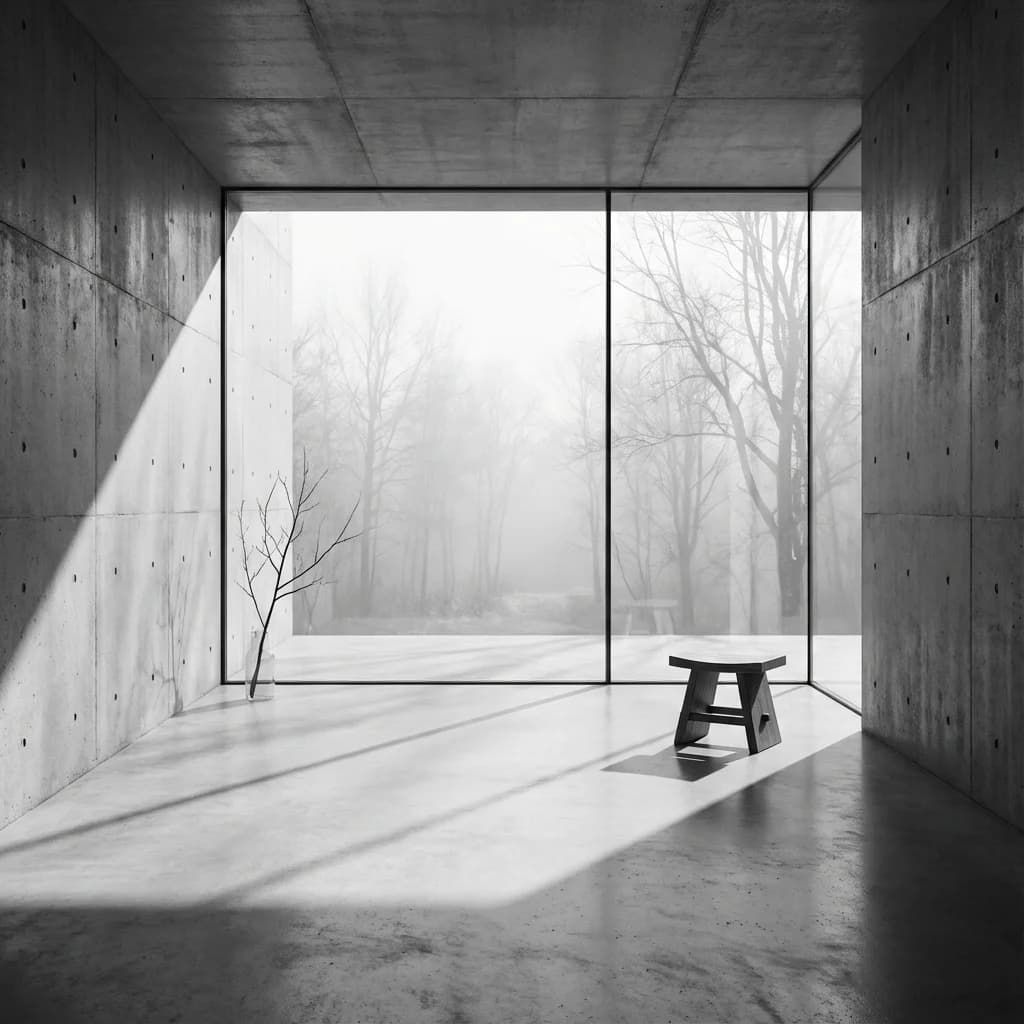
Minimalism is often misunderstood as a lack of detail, a barren emptiness, or a cold austerity. True architectural minimalism is the polar opposite: it is the rigorous pursuit of perfection, where every line exists for a reason, and every distraction is ruthlessly removed to reveal the true essence of space and light.
In the chaotic world of the 21st century, minimalism acts as a spatial antidote. It is not about living with less for the sake of deprivation; it is about making room for what truly matters.
The Art of Subtraction
The famous architect Mies van der Rohe popularized the phrase "Less is More," but the concept goes deeper. Antoine de Saint-Exupéry beautifully articulated the principle: "Perfection is achieved not when there is nothing left to add, but when there is nothing left to take away."
In the context of fenestration and door systems, this philosophy mandates the elimination of the non-essential:
- No chunky frames blocking the view.
- No visible hinges disrupting the clean lines.
- No bulky handles protruding into the space.
By subtracting the visible hardware, we amplify the sensory experience of the environment. The architecture recedes, allowing life to take center stage.
Engineering Invisible Strength
There is a delicious irony in minimalism: Achieving visual simplicity requires maximum engineering complexity. It is infinitely harder to hide a mechanism than to show it. To make a door look like nothing but a sheet of moving glass requires creating a support system that is incredibly sophisticated.
At Slidy Doors, we achieve this through:
1. Concealed Frames: Our tracks are designed to be buried flush with the finished floor, and our jambs are hidden within the wall cavities. The result? A glass wall that emerges directly from the building structure.
2. Effortless Motion: A sliding panel can weigh up to 1,000 kilograms. To make it move with the push of a finger requires custom-engineered stainless steel rollers and precision bearings that distribute the load perfectly.
The Human Impact: Why It Matters
Why do we crave these clean lines? The answer lies in cognitive psychology. Cluttered spaces lead to cluttered minds. Visual noise creates a subconscious cognitive load, keeping our brains in a state of low-level alert.
By reducing visual noise, we create environments that promote:
- Calm & Serenity: A neutral canvas for the mind to rest.
- Focus: Fewer distractions lead to deeper concentration.
- Connection: Without barriers, our connection to the outside world is strengthened.
Conclusion
The "Less is More" ethos is not just an aesthetic choice; it is a design for a better way of living. By placing the human experience at the center of the architectural stage, we create homes that are not just machines for living, but sanctuaries for the soul.